In this story
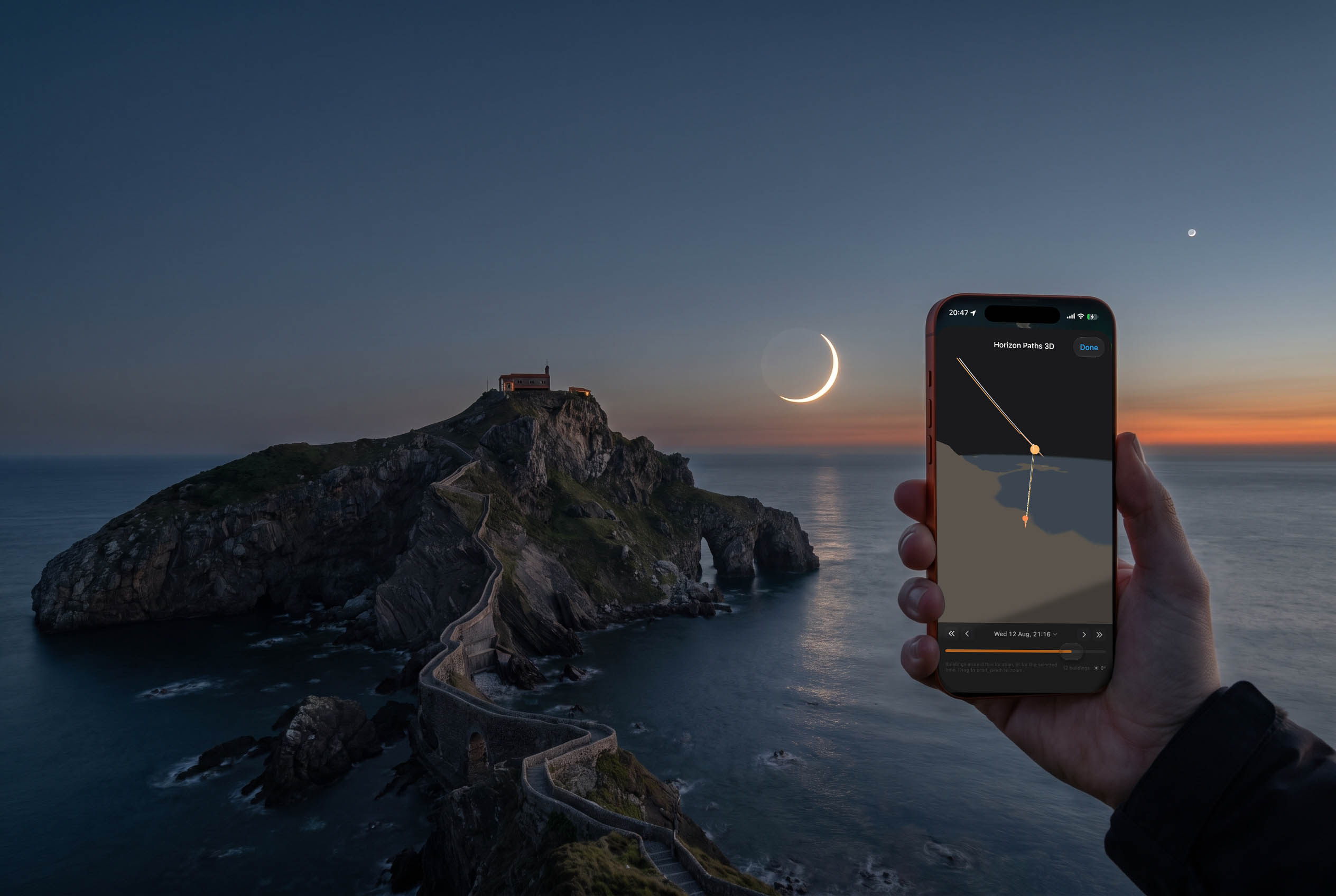
On the twelfth of August, a total solar eclipse swept across Iceland and northern Spain, and it produced some of the most striking eclipse photographs in years. Not because the eclipse was unusually long. Because it happened low over the horizon, in the evening, with landscapes underneath it. That combination is rare, it is plannable, and the next five years are full of chances. Here is how eclipses work, how to photograph them, and how to plan one down to the minute before you ever book a flight.
The day before, our time-travelling photographer Nigel North showed the whole planning move in sixty seconds, lining up sun and moon in the 3D Diorama for the "Dragonstone" coast at San Juan de Gaztelugatxe:
Planning the eclipse at Dragonstone. If the player does not load, watch it on YouTube.
Total vs. ring of fire
Every solar eclipse is the same trick: the moon passes exactly between you and the sun. What decides whether you get a total eclipse or a "ring of fire" is nothing more than the moon's distance from Earth that day.
The moon's orbit is an ellipse. At perigee it is close enough to appear about 6% larger than the sun; at apogee it appears about 8% smaller. When the moon is close, it covers the sun completely: day collapses into twilight, the corona appears, and for a few minutes you can look at the sun with bare eyes. That is a total eclipse. When the moon is too far away, it cannot cover the whole disc, and at the moment of perfect alignment a blazing ring of sunlight remains around the black moon: an annular eclipse, the ring of fire. Beautiful, but the sky never goes dark and the filter never comes off.
Inverza renders this honestly: since version 1.6.3, the moon in the AR Sky and the 3D Diorama is drawn at its true apparent size for any date, so you can literally see whether it will fit over the sun.
How often does this happen?
More often than most people think. Somewhere on Earth there are between two and five solar eclipses every year. The catch is the word "somewhere": the moon's shadow track is only a few hundred kilometres wide, so any single spot on Earth waits on average around 375 years for a total eclipse to come to it. Eclipse photography is therefore travel photography. You do not wait for the eclipse; you go to it.
How to photograph one
First, safety, without exception: certified eclipse glasses for your eyes and a proper solar filter for the lens during every partial phase. Only during the minutes of totality, and only in a total eclipse, does the filter come off. In an annular eclipse it never does.
Second, the creative part. The single biggest difference between a good eclipse photo and a great one is the sun's altitude. A high-noon eclipse hangs isolated in an empty sky. An eclipse low over the horizon sits inside a landscape: a telephoto compresses the eclipsed sun against ridgelines, castles, or the sea, and the entire scene picks up the strange metallic storm light. That is exactly what made August 2026 special: totality arrived in the evening with the sun barely ten degrees above the Atlantic. Low sun also means the light path through the atmosphere is long, so colour arrives for free.
Practical settings for totality: tripod, filter off, and bracket wildly, from 1/1000 s for the inner corona to half a second for the outer streamers. For the partial phases and the ring, keep the filter on and expose for the sun's surface. And plan a wide shot too: the darkened landscape under a total eclipse is half the story.
Planning it with Inverza, from your sofa
Every eclipse through 2030 is built into Inverza with the official NASA/GSFC eclipse geometry, accurate to the kilometre at the edges of the path. The workflow:
- Pick a candidate region from the list below and drop a spot in Inverza, then open the 3D Diorama straight from the spot.
- Scrub the Diorama's time slider to the eclipse date and time. The sun and moon travel their real arcs over a real 3D model of the terrain, and when their discs overlap, an eclipse percentage appears next to the altitude readout. 100% means totality at that exact spot; an annular maximum shows the honest ring value instead.
- Slide along nearby spots to find where the geometry meets a foreground worth photographing: a ridge, a monument, a coastline. The Diorama shows the sun's exact compass direction and altitude over the actual terrain, so you know whether the eclipsed sun will clear that hill or sink behind it.
- On location, open AR Sky. The sun and moon paths are drawn onto the live camera image, so you can stand at your chosen spot the day before, hold up the phone, and see precisely where the eclipse will happen relative to your foreground. Fine-tune your tripod position by metres, not guesses. The full home-then-field workflow is the same one we walked through in Plan the frame to the minute.
Where the shadow goes next
All times below are for the exact coordinates given. Set the app to the local time listed and the Diorama will show the maximum. Face the compass direction to find the sun.
6 February 2027, annular - South America
The ring of fire crosses Patagonia mid-day. High sun, so this one is about the ring itself.
- Viedma, Argentina: 40.810° S, 63.000° W. Ring at 12:14 local (15:14:08 UT), sun 60° high, face NE. The ring lasts 6 minutes 53 seconds.
- Mar del Plata, Argentina: 38.000° S, 57.550° W. Ring at 12:29 local (15:28:46 UT), sun 66°, face NNE. 7 minutes 23 seconds of ring.
2 August 2027, total - Spain to Egypt
The century's long one: over six minutes of totality in Upper Egypt. Two very different photographs on one track: a morning eclipse over the Strait of Gibraltar, or near-zenith totality above the temples of Luxor.
- Luxor, Egypt: 25.699° N, 32.639° E. Totality around 13:06 local (10:05:49 UT), sun 82°, almost overhead, face SSW. The longest totality on land this century: 6 minutes 20 seconds.
- Tangier, Morocco: 35.770° N, 5.800° W. Totality around 09:47 local (08:47:27 UT), sun 38°, face E over the Strait. 4 minutes 51 seconds from the medina rooftops.
- Tarifa, Spain: 36.014° N, 5.606° W. Totality around 10:48 local (08:47:45 UT), sun 38°, face E along the Strait. 4 minutes 40 seconds at the southernmost point of mainland Europe.
- Chefchaouen, Morocco: 35.169° N, 5.269° W. Totality around 09:48 local (08:47:53 UT), sun 39°, face E. 4 minutes 12 seconds of darkness over the blue city.
- Cadiz, Spain: 36.530° N, 6.290° W. Totality around 10:47 local (08:47:09 UT), sun 38°, face E over the Atlantic. 2 minutes 57 seconds; the towns nearer the centreline above get more.
26 January 2028, annular - Galapagos to Iberia
The photographer's annular: the track ends at sunset in southern Spain, putting the ring of fire a few degrees over the Atlantic horizon. This is the low-sun composition of the decade.
- Cadiz, Spain: 36.530° N, 6.290° W. Ring at 17:56 local (16:56:09 UT), sun just 8° above the sea, face WSW. Sunset ring over water, and it lasts 6 minutes 26 seconds.
- Seville, Spain: 37.390° N, 5.990° W. Ring at 17:56 local (16:56:03 UT), sun 7°, face WSW, with the city skyline as foreground. 7 minutes 13 seconds of ring.
- Galapagos Islands, Ecuador: 0.740° S, 90.300° W. Ring at 07:25 local (13:25:10 UT), sun 17°, face ESE. Morning ring over the Pacific, 5 minutes 15 seconds.
- Baelo Claudia, Bolonia, Spain: 36.089° N, 5.774° W. Ring at 17:56 local (16:56:28 UT), sun 8°, face WSW. 4 minutes 3 seconds of ring beside 2,000-year-old Roman columns on the Atlantic shore.

22 July 2028, total - Australia and New Zealand
Totality crosses the outback and passes directly over Sydney in mid-afternoon winter light, then reaches New Zealand's Southern Alps with the sun low in the north-west.
- Sydney Opera House, Australia: 33.857° S, 151.215° E. Totality at 14:02 local (04:01:52 UT), sun 29°, face NNW across the harbour. 3 minutes 40 seconds.
- Queenstown, New Zealand: 45.030° S, 168.660° E. Totality at 16:17 local (04:16:45 UT), sun only 10° over the mountains, face NW. 2 minutes 53 seconds of low-sun totality over the Remarkables.
1 June 2030, annular - Mediterranean morning
The ring crosses North Africa and Greece just after sunrise, then runs to Siberia and Japan.
- Athens, Greece: 37.980° N, 23.730° E. Ring at 07:58 local (04:57:57 UT), sun 20°, face ENE. Morning ring beside the Acropolis, 3 minutes 46 seconds.
25 November 2030, total - southern Africa
A morning totality sweeping from the Namib desert across South Africa.
- Windhoek, Namibia: 22.570° S, 17.080° E. Totality at 07:20 local (05:19:52 UT), sun 17°, face ESE. Low desert-morning totality, 1 minute 38 seconds.
- Durban, South Africa: 29.860° S, 31.030° E. Totality at 07:35 local (05:35:00 UT), sun 34°, face E over the Indian Ocean. 2 minutes 33 seconds.
The short version
Twice a year or more, somewhere on Earth, the moon fits over the sun. Whether you get darkness or a ring of fire is a question of lunar distance, and whether you get a snapshot or a photograph is a question of planning: find the path, find a foreground, check the geometry in the Diorama from home, then verify it through AR Sky when you arrive. The 2026 eclipse rewarded the people who did exactly that. The 2027 and 2028 tracks will do the same.
Eclipse predictions by Fred Espenak, NASA's GSFC.
